Run a lunar logistics company.
You are not the astronaut. You are the operator who decides where the drill goes, which contracts are worth signing, and who loses power when the batteries run low.
Distance has a cost.
The loop
-
1
Read the site
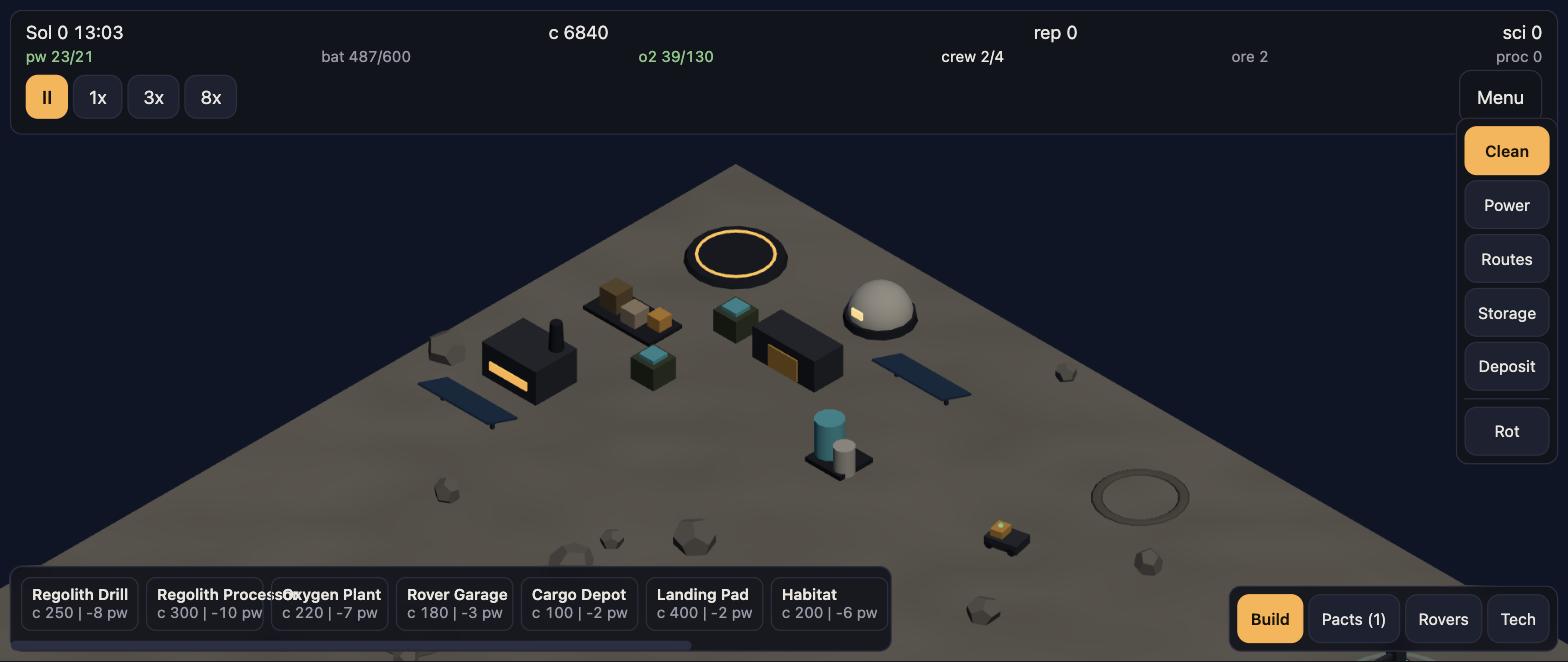
Every site is generated from a seed: one mineral deposit in a far corner, scattered rock that blocks construction, and a starter base on the flat ground near the pad.
-
2
Sign the right contracts
Offers arrive about twice a sol. Deliver processed regolith, produce oxygen, hold a reserve for a research crew. Reputation unlocks the big orders. Miss a deadline and you pay for it in reputation.
-
3
Build the chain
Drill on the deposit, processor near the base, depot for export. Nine module types, each with one clear job and a power bill attached to it.
-
4
Route the rovers
Rovers haul on the routes you assign. They drain battery per cell travelled and divert to the garage to charge. A rover idling at an empty source is your bottleneck, made visible.
-
5
Survive the night, then scale
Solar output falls to zero after sunset. Batteries decide whether the refinery keeps running or the habitat gets the last kilowatt. Research points buy fifteen upgrades across two tiers.
Time, and the six things you count
The whole game runs on one clock and six numbers. Knowing what they mean before you start saves the first ten minutes of squinting.
One sol is six minutes
A lunar day is called a sol. Each one is 1440 simulated minutes, which is six real minutes at normal speed, and you can pause or run at three or eight times. Daylight is 06:00 to 18:00: solar arrays make nothing outside it, so half of every sol runs on whatever you stored. Speed changes how fast time passes and never what happens, so nothing is decided by how fast you can click.
-
pw Power
Generated against consumed, live. Runs the whole base and disappears every night. When it runs short the network throttles in priority order, drills first and habitats last.
-
bat Batteries
What carries you from sunset to sunrise. Undersize them and production stops in the dark; oversize them and you paid for capacity you never fill.
-
o2 Oxygen
Crew breathe it constantly, oxygen plants make it, and some contracts buy it. Run out and crew leave one per sol until you fix it. Nobody dies, you just get smaller.
-
ore Ore and processed regolith
The industrial chain. Drills mine ore, processors refine two ore into one processed unit, rovers move both. Only stock at a depot or the landing pad counts as delivered.
-
c Credits
Money, earned from contracts and spent on modules, rovers and upgrades. There is no passive income: if nothing is being delivered, nothing is being earned.
-
rep Reputation and research
Reputation is the gate on bigger contracts, gained by delivering and lost by missing deadlines. Research buys permanent upgrades, so early ones compound.
Systems you can actually see
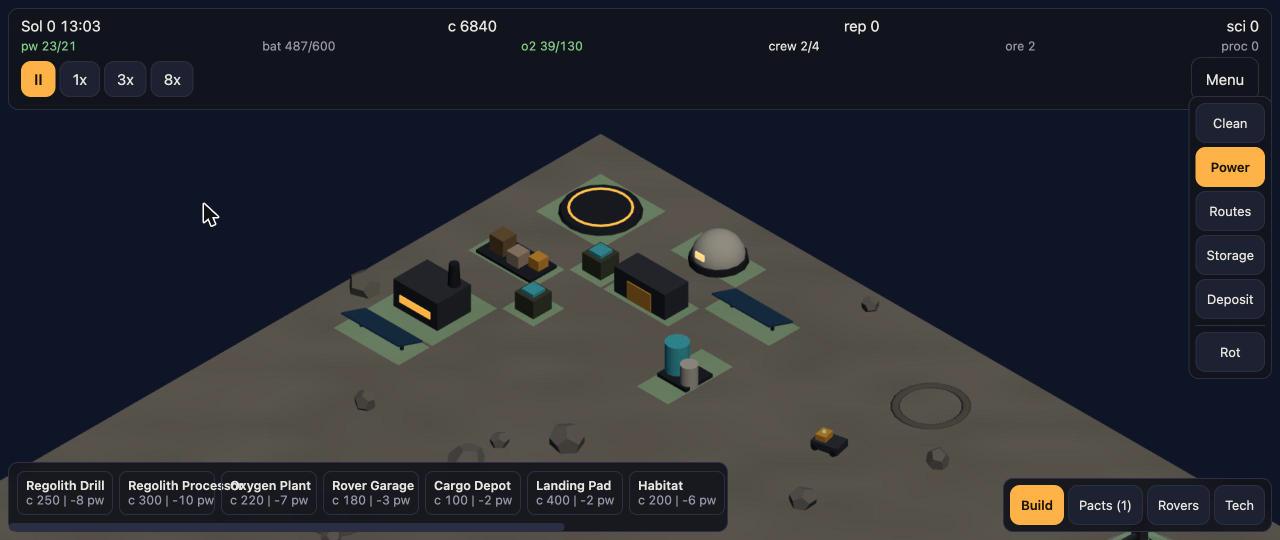
A power grid that sheds load, not games
Production follows a daylight curve. Surplus charges batteries, deficit drains them, and when the reserve is gone the network throttles in priority order: drills first, habitats last. Nothing explodes and there is no game over. Buildings run at a fraction of their rate until you fix the layout.
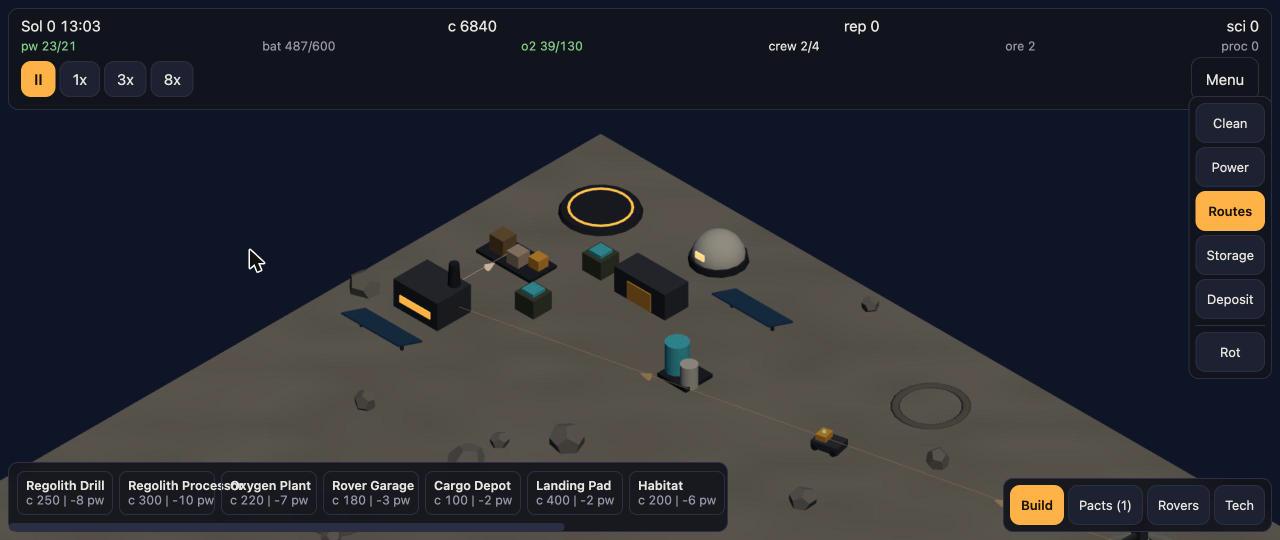
Logistics on a map where layout hurts
The rich deposit is deliberately far from the habitat. Every cell between them is battery drained and minutes lost. Put the processor next to the drill and you shorten the ore haul but lengthen the export run. There is no correct answer, only the one your contracts can live with.
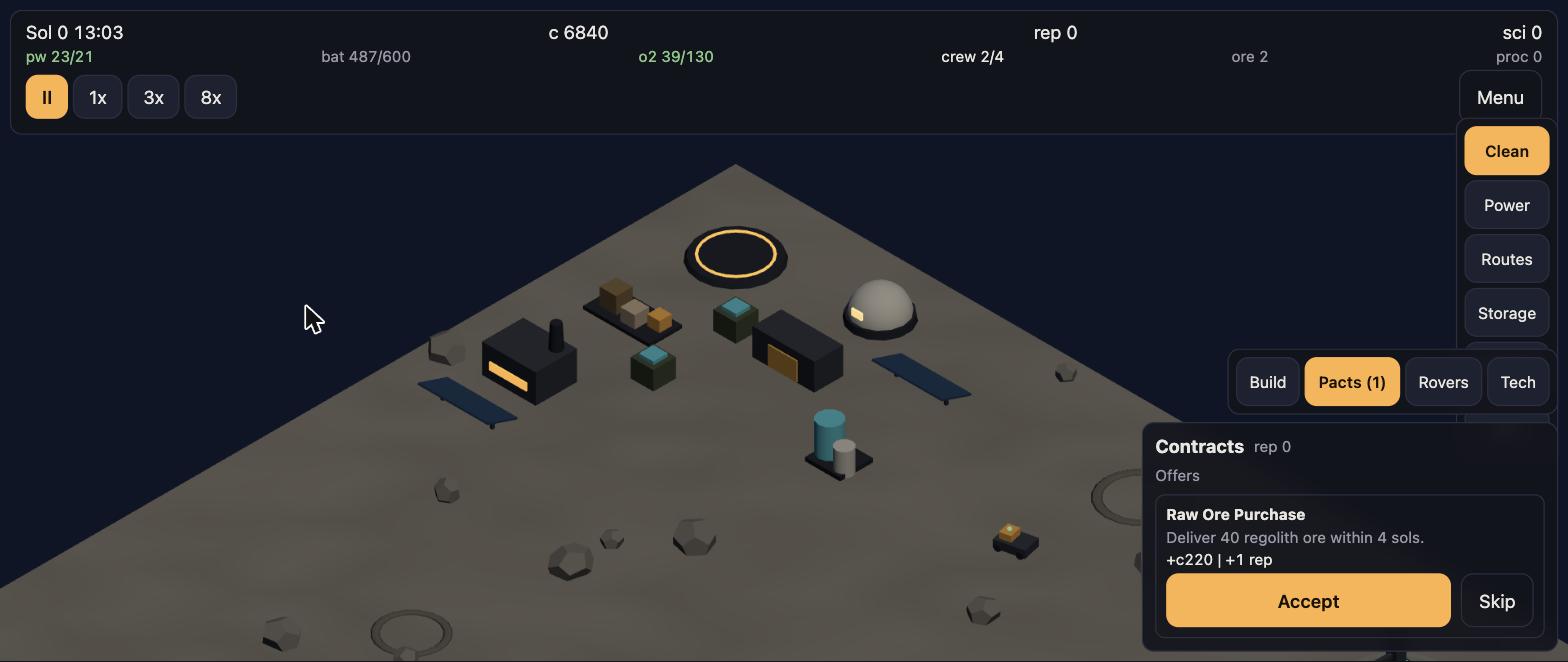
Contracts with real opportunity cost
Four active jobs at a time. The lucrative refining order wants the same power your habitat expansion needs. Deliveries settle the moment the goods are sitting in a depot or on the pad, so hitting the target early pays early.
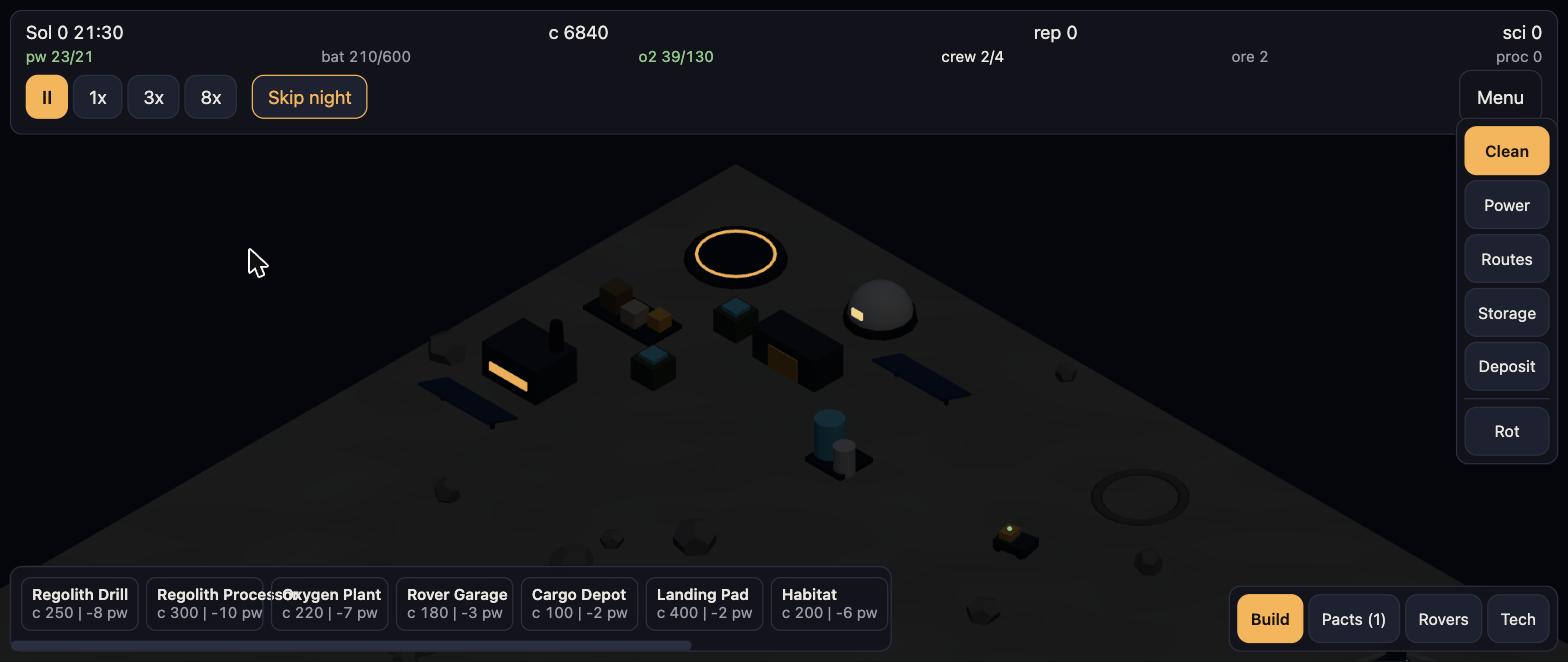
Night is a constraint, not a waiting room
One sol is 1440 simulated minutes and six real ones. When the sun is down and there is nothing to decide, Skip night fast forwards to sunrise: every minute still runs, so batteries drain, crew breathe and deadlines advance. It saves your time, not your outpost.
Built to be a game first
-
Runs in the browser
No download, no launcher. It installs as an app if you want it on a home screen, and it keeps working with no connection.
-
Touch first
Tap to select, drag to pan, pinch to zoom, ghost placement with confirm and cancel. The same build works on a phone and on a desktop.
-
Deterministic sols
A fixed simulation step and a seeded generator, so the same seed gives the same site and slow hardware never changes the balance.
-
Save where you like
Local saves need no account. Sign in and you get an autosave every sol plus eight manual cloud slots, synced across devices.
Your site is waiting.
Twenty two by twenty two cells of regolith, one deposit, and a supply of contracts.
Start an outpost